

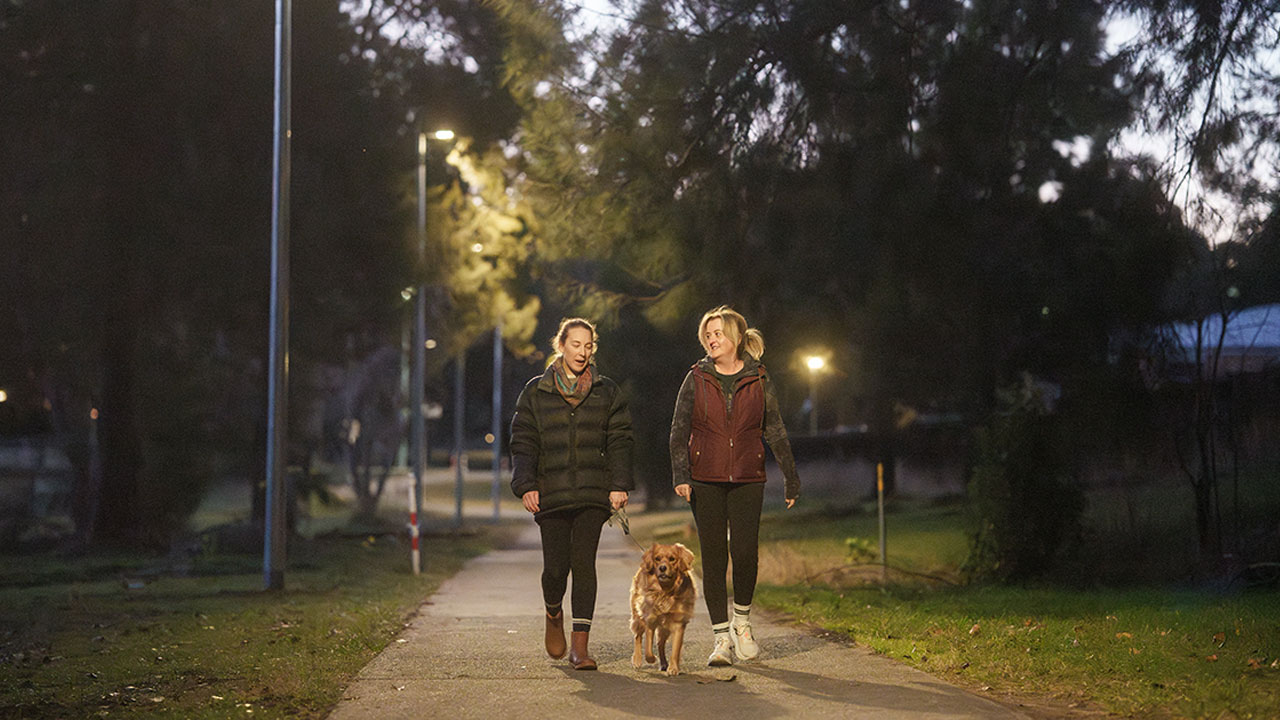
Good lighting in public areas makes it easier and more appealing to stay out after dark.
26 May 2026
In brief:
- Most of Canberra’s streetlights are managed by the ACT Government.
- These are transitioning to energy-efficient LED technology.
- The community plays a key role in reporting streetlight faults.
- This story includes information you may not know about streetlights in the ACT.
The ACT Government maintains more than 83,000 streetlights across Canberra.
As well as lighting up our roads, streetlights are installed along footpaths, parks and other public spaces.
Most people don’t give much thought to streetlighting; however, this simply means it’s doing its job.
Why is good lighting so important?
Good lighting provides huge benefit to the community.
It helps keep the city safe and easy to get around at night. In well-lit areas, it’s easier to see hazards, signs and road conditions. This helps prevent motor accidents and keeps pedestrians and cyclists safe.
Good streetlighting makes it easier to stay out later – whether you’re walking the dog, playing in the park or going out for dinner.
Streetlights also play a key role in:
- deterring crime
- wayfinding and navigation
- supporting emergency services
- helping the community feel secure.
The ACT Government’s City Services teams carry out regular night patrols. They do this to check for streetlighting faults. They also rely on community reports.
How can I report a broken streetlight?
If you see a streetlight that isn’t working properly, you can report it through Fix My Street. You can also call Access Canberra on 13 22 81.
Common issues like blown globes, weather damage or condensation are usually fixed within five business days.
More complex faults may take longer. You can see the status of outstanding cable faults on the City Services website. These are arranged by region and updated each Friday.
Streetlights can become a hazard when faulty. Please do not touch them.
Can I ask for a streetlight upgrade?
You can request new or upgraded lighting via Fix My Street.
A range of factors are considered when assessing such requests.
These factors include:
- supporting public and road safety
- encouraging public transport
- reducing energy consumption
- minimising light pollution
- adhering to heritage requirements and planning rules.
What kind of technology is used in ACT streetlights?
The ACT Government is upgrading streetlights through its streetlight upgrade program.
They are transitioning from old compact fluorescent lamps to new LED ones.
The new lamps:
- use less energy, which results in lower running costs
- direct light only where it is needed
- last up to 20 years – traditional streetlights last just 4-8-years.
So far, over 62,000 lights have been upgraded around Canberra. The rest will be upgraded over the coming years.
Over 26,000 streetlights are also equipped with smart technology. This means they can:
- self-detect faults
- report back if repairs are needed
- dim automatically.
What is light pollution?
The streetlight upgrade program is combatting light pollution.
This type of pollution occurs when artificial light at night is:
- too bright
- not directed properly.
It creates a glow in the sky that can:
- harm the environment
- affect people’s health
- waste energy
- disturb animals – particularly nocturnal ones – and ecosystems
- make it hard to see the stars.
Does Canberra use adaptive lighting technology?
Trials of adaptive lighting are underway in the ACT. These include:
- dimming streetlights late at night
- using motion sensors to adapt to movement in areas with low activity.
This technology helps save energy and reduce impacts on wildlife, all while keeping streets safe.
Trials have run in:
- Throsby
- Molonglo Valley
- along Athllon Drive
- near Mulligans Flat Nature Reserve.
Extra measures can be used in some areas, such as around Mount Stromlo and Canberra Airport. These include glare shields and special lenses to ensure light is directed correctly.
The ACT Government is also looking at using adaptive lighting on footpaths. Lights would dim when no movement is detected on the path for a short time. They would then turn off during longer periods of inactivity.
Lighting installed in the following areas includes some sensors:
- Bowen Park (Barton)
- Eastlake Parade (Kingston)
- Dickson shopping precinct.
What about streetlights on National Land?
Lighting on National Land in Canberra is managed by the National Capital Authority (NCA).
The areas of National Land administered by the NCA include:
- the National Triangle
- Lake Burley Griffin and parts of the foreshore
- Anzac Parade
- Diplomatic Missions in Yarralumla, Deakin, Curtin and O'Malley.
Why are some streetlights taller than others?
Streetlight height and spacing are dictated by the category of road or path they are on.
Taller poles are used on highways and main roads. Residential streets have shorter poles and pedestrian areas shorter again.
Taller poles spread light over a larger area, so generally fewer are needed. However, this must be balanced with the area’s specific requirements.
Factors that determine streetlight height include:
- how much light is needed
- energy efficiency
- safety considerations
- aesthetic impact
- environmental impact
- local planning rules.
What about lighting around bus shelters?
While most bus shelters rely on overhead street lighting, several of Canberra’s iconic concrete bus shelters have been fitted with solar lighting.
This has helped to improve users’ personal security. It has also added to enhanced community wellbeing.
Bus stops with solar lighting are listed on the City Services website.
Find out more
- Read more on how the ACT Government manages streetlighting on the ACT City Services website.
- Read the National Capital Authority’s outdoor lighting policy on the NCA website.
Read more like this:
Get ACT news and events delivered straight to your inbox, sign up to our email newsletter: