Building a more responsive, flexible and future-focused skills system
As we emerge from COVID-19, our resilience and future prosperity depends on our capacity to skill our workforce for the jobs of the future. We must strengthen both technical skills and broader capabilities to ensure an agile and adaptive workforce, and drive entrepreneurship, innovation and future growth.
The ACT Government is committed to working with industry experts, education and training providers and employers to ensure we have the right strategies in place and fit-for-purpose training products.
As the nation's capital, the ACT's employment profile and economy have traditionally been dominated by the government sector. However, over the last decade, we have seen strong growth in knowledge-intensive sectors such as professional, scientific and technical services, healthcare and social assistance, research and information systems.
While we can't predict with certainty what will power our economy in the future, there are strong signs that certain key sectors will play a leading role.
We seek to strengthen local skills and training capability in these areas to ensure tomorrow’s workers have the right skills to take advantage of expected jobs growth.
- Technology industries – building on our knowledge capabilities in areas like space, cyber security, renewables and digital technologies. The ACT has significant advantages as the home of some of Australia’s leading research and scientific institutions. Tomorrow’s technology jobs will call for a mix of skills, which draws from the best of the university and vocational education sectors.
- Building and construction industries – supporting the ACT Government’s record investment in infrastructure and our commitment to achieve net zero emissions by 2045. Tackling long-running industry skills shortages, while training workers for emerging priorities like sustainable building and the circular economy, will ensure workers benefit from our city’s ongoing growth and development.
- Caring industries – enabling the significant expansion of workforces necessary to improve wellbeing, quality of life and care for the most vulnerable in our community. Significant Commonwealth and ACT Government commitments in aged care, early childhood education and care, disability services and health care more broadly, will drive increased investment in these sectors in years to come. Meeting the ambition of these commitments means skilling many more workers to build and sustain rewarding careers in these critical sectors.
- Experience industries – re-building vibrant and innovative tourism, hospitality and arts businesses after the major upheavals of COVID-19. The pandemic has brought about a fundamental shift in many business models. Building resilience across the experience industries depends on establishing a strong local skills pipeline to develop and retain workers with a range of flexible and adaptive skills.
In partnership with industry and local training providers, the ACT Government will promote the rewarding career opportunities in these sectors to school students, school leavers and workers looking to reskill or upskill.
How we are delivering
- We will review the range and types of courses delivered through government funding to ensure public investment is keeping pace with rapidly-changing local, national and global business needs. We have embarked on a significant renewal of CIT’s course mix and offerings to ensure best-fit with industry and student needs today, and the skills needs of new and emerging industries.
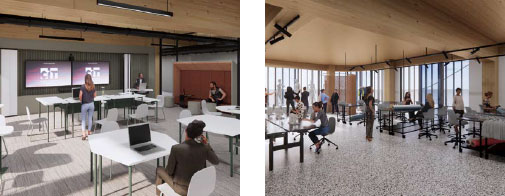
- We are delivering the CIT Woden campus to support flexible learning and thousands of learners into the jobs of the future. The campus will feature state-of-the-art learning facilities and flexible learning options, with smart classrooms to support e-learning, simulated learning environments, commercial kitchens and hands-on training spaces.
- We will continue to support Australian Apprenticeships and, in partnership with the ACT Building and Construction Training Fund Authority, programs to improve completion rates and increase women’s participation.
- We will develop future-focussed skills pathways—for new and existing workers—which recognise the changing nature of work in knowledge-intensive sectors. Options may include degree apprenticeships, which combine employment with university study, and dual-sector micro-credentials, which provide a unique mix of vocational training and higher education to allow workers to keep up-to-date with cutting-edge technology and the latest industry trends.
- We will work with industry on post-trade pathways, including short courses in new technologies and materials that support upskilling for sustainable construction and our city’s renewable energy transition.
- We will work with the Australian Government, state and territory governments, and other key stakeholders, to design an approach to micro-credentials that harnesses potential for lifelong learning as jobs change, without displacing or undermining full accredited qualifications.
Local success story
Banda Ramadan completed a Certificate IV in Cyber Security at the Canberra Institute of Technology. Previously, she taught computer science and software engineering courses at universities in Jordan and Saudi Arabia.
Since moving to Australia, Banda has embraced the cyber security industry and is passionate about addressing skills shortages in the technology sector. Banda chose vocational training for its balance of theoretical concepts and practical hands on experience.
Banda secured a role as a cyber defence specialist in a local telecommunications company.
“This experience was a chance to learn new skills and become more resilient.”
Investing in modern training facilities: CIT Woden

The ACT Government is investing up to $300 million in a state-of-the-art CIT campus and Youth Foyer for Woden, stimulating the local economy and supporting the revitalisation of the Woden Town Centre.
We are delivering these new educational and community facilities in a central, well connected part of Woden, complemented by a new public transport interchange. The 22,500m2 new campus will be home to around 6,500 students.
Delivering a contemporary and sustainable CIT campus in the heart of Woden will be a huge boost to the delivery of vocational education and training in the ACT. Smart classrooms, state-of-the-art simulated learning environments, commercial kitchens and hands-on training spaces will help students achieve their full potential in areas such as IT, cyber security, hospitality and business. Community and commercial facilities will complement activated common areas across the campus.
This new campus will be much more than a building – it will ensure CIT remains a provider of choice and an agile partner to meet industry, business and community needs, by delivering quality vocational education and training for the jobs of the future.
The move to Woden will mark the start of a new era for CIT and the provision of high quality skills and training in the ACT.
CIT Woden Youth Foyer
The Woden campus will house a dedicated Youth Foyer to support young people who are at risk of, or are experiencing homelessness, by providing accommodation and support services co-located with the Woden campus. By combining housing with opportunities to pursue education and training in the one location, the Youth Foyer will help young people overcome challenges to fulfil their potential.
The Youth Foyer will provide housing for up to 20 young people between the ages of 16-24. The aspiration for the design is to build a welcoming, comfortable, secure place for residents they can be proud to call home. Linking youth foyers to educational institutions is considered best practice in wrap-around service delivery. Locating a youth foyer directly into an educational institution will showcase this world-leading integrated model right here in Canberra.