
Report a radiation incident
You have a responsibility to use a radiation source safely and in accordance with the radiation management plan relevant to that particular source.
Occasionally something will occur that results in an unplanned exposure to radiation. This is called as a radiation incident.
Defining a radiation incident
A radiation incident defined in the National Directory for Radiation Protection (2nd Edition, 2021) (NDRP) as:
Any unintended or ill-advised event when using ionising radiation apparatus, specified types of non-ionising radiation apparatus or radioactive substances, which results in, or has the potential to result in, an exposure to radiation to any person or the environment, outside the range of that normally expected for a particular practice, including events resulting from operator error, equipment failure, or the failure of management systems that warranted investigation.
A list of the types of incident which should be reported for each type of radiation practice is in Schedule 4 of the NDRP.
Report an incident
If a radiation incident happens, you must report it to the Health Protection Service (HPS).
All radiation incidents must be reported. How quickly you need to report the incident, and how to report it, depends on how severe it is and how much radiation people may have been exposed to.
To help assess the risk, incidents have been grouped into four levels called Risk Potentials (RPs). These levels are based on the amount of radiation involved.
HPS may ask for more information about an incident, including radiation dose calculations.
The Table below provides:
- the radiation dose ranges for each RP level
- how quickly the incident must be reported
- the required reporting method for each RP level.
RP1 | RP2 | RP3 | RP4 | |
|---|---|---|---|---|
Conditions | Unjustified dose^ ≤ 1 mSv. (less than or equal to 1 mSv) | Unjustified dose^ > 1 mSv, ≤ 10 mSv. (greater than 1 mSv and less than or equal to 10 mSv) | Unjustified dose^ Ϯ > 10 mSv. (greater than 10 mSv) | Unjustified high dosesϮ : exceeding 0.25 Sv whole body, 0.75 Gy organ dose, 6 Gy skin dose*. RP4 also Includes:
|
Typical setting |
|
|
|
|
Reporting timeframe |
|
|
|
|
Reporting format |
| Written report | Written report | Written report |
^ An "unjustified dose" is a radiation exposure that does not provide a sufficient net benefit to the individual. For example, a patient is re-scanned due to a poor-quality image, such as in dental or medical imaging. The dose from the first image in this case is an unjustified dose.
Ϯ includes both incidents where the dose was administered, and incidents of ‘near-misses’, where the dose administration was narrowly avoided, as this may provide a significant learning opportunity.
* As per NDRP2 guidelines.
Φ A radionuclide spill is the unintended release of radioactive material outside its intended containment vessel, which contaminates or has potential to contaminate people or the environment, including staff.
# A radiation dose to a member of the public or staff, within a radiation controlled area, that is unintended, unplanned, or outside the scope of an authorised radiation practice.
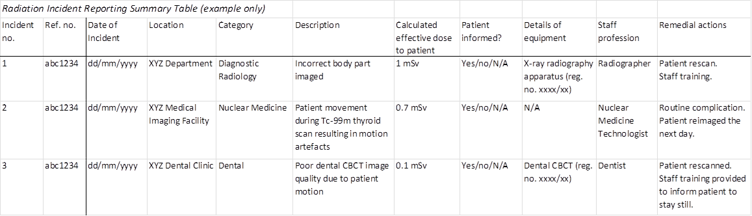
The incident reporting for RP1 can either be as a written report or in the format of a bulk summary table (spreadsheet) that is interchangeable with the written report. A typical bulk summary table with various examples for different departments or clinics is provided below:
HPS will review the incident report and, where necessary, the incident will be reported to the Australian Radiation Incident Register (ARIR), which is administered by Australian Radiation Protection and Nuclear Safety Agency. You are not able to report the radiation incident directly to the ARIR. All incident reports uploaded to ARIR are anonymised to protect the privacy of the people involved.
Every radiation incident can be used as a learning opportunity to make improvements to radiation safety.