
Black Gum (Eucalyptus aggregata)
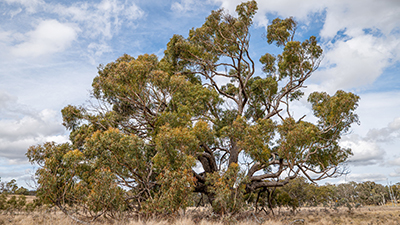
Description
- The Black Gum is a small to medium woodland tree that grows up to 18 m tall.
- Its trunk and main branches have dark-grey-black, fibrous or flaky bark that doesn’t shed every year.
- Its top branches and twigs are smooth, and it has whitish or greyish bark that sheds yearly.
- Its young leaves are narrow and oval, dull green and arranged opposite each other.
- Its adult leaves are slightly curved, round-ended measuring 12 cm long and 1-2 cm wide. Its leaves are glossy dark green on both sides.
- It has buds, flowers, and fruits that grow in tight clusters of 7 on short stalks that are 3-4 mm long. The buds are egg-shaped and are 3-5 mm long and 2-3 mm wide.
- Its white flowers turn into gum-nuts that are cone- or cup-shaped, and are 2-4 mm long and 3-5 mm wide.
- It flowers from November to May and is pollinated by insects such as native bees, birds, and mammals.
- Seeds are spread by wind, water, and gravity and fall mainly in late summer and early autumn.
- It can live for over 100 years and usually starts reproducing in under 20 years.
Find out more about the Black Gum on Canberra NatureMapr.
Where are they
The Black Gum is found in NSW and the ACT. A small group of the species is also found in Woodend in Victoria.
There’s less than 10,000 mature Black Gum left, with most located in central and southern highlands of NSW.
It grows well in:
- poorly drained flats
- hollows near swamps, creeks and rivers
- slopes up to 8 m above waterline
- wetter, cooler and higher parts of the tablelands
- altitudes of 600–1200 m with annual rainfall of 600–900 mm
It is often found growing in open woodlands with a grassy layer of River Tussock (Poa labillardierei) or Kangaroo Grass (Themeda triandra) and with other eucalypts such as Snow Gum (Eucalyptus pauciflora), Manna or Ribbon Gum (Eucalyptus viminalis), Candlebark (Eucalyptus rubida), Black Sallee (Eucalyptus stellutata) and Swamp Gum (Eucalyptus ovata).
Conservation threats
Threats to the Black Gum include:
- clearing of its habitat
- habitat fragmentation preventing movement of genes between trees and populations
- not enough new trees growing
- mixing with other species, creating hybrids
- climate change.
Conservation status
- National – Vulnerable (Environment Protection and Biodiversity Conservation Act 1999).
- Australian Capital Territory – Vulnerable (Nature Conservation Act 2014)
Conservation actions
Conservation aims to maintain known populations of the Black Gum, including to:
- keep and grow the number of trees
- improve and protect current and potential habitats
- reduce threats to the species where possible
- find ways to connect, improve, or create new populations
- increase local awareness about the species
- mark the species’ location on maps
- limit the removal of the species
- fence off mature tree areas to protect them from grazing and encourage recruitment
- control weeds that prevent growth
- plant more of the species around existing areas
- add signage near important roadside populations.